Our latest installment: This Side of Paradise (03-02-1967)
There was no drink this time ("who wants to counteract paradise, Jim-boy!"), but if I had my act together, I'd have come up with a Mint Julep.
Andy and I did a podcast for this one last year: check it out here.
Eric begins this time:
This will be a short review. Not because “This Side of Paradise" isn’t a good original Trek episode. Actually, it’s in my top twenty (maybe ten) favorite episodes, but Doc and Andy already did a podcast that covers it very nicely.
All in all, it’s a good story. The science is best left unexamined, but the intent is to look at what happens when people are offered (or in this case, thrust into) paradise. Does it work? Can they be content?
But before we get to that, a few thoughts about the character development in this episode. Spock gets the spotlight and the girl, both of which are good to see. We get a rare glimpse at his human half and the “self-made purgatory" he lives in thanks to Leonard Nimoy’s wonderfully sympathetic performance. Spock’s loneliness and quiet dignity are quite touching, and his gentleness with Leila Kalomi (especially when he has to reject her) gives a clue to why the character was, and perhaps still is, so popular with women. I also heard an interview with Nimoy where he said that he got a great many letters from teenagers in relation to this episode, most likely because Spock’s isolation and feelings of being alone and misunderstood quite understandably resonated with teenage kids.
So now to the premise of the story: humans are not meant for, or well-suited to, paradise. The only reason the colonists and the Enterprise crew are happy and content in the idyllic existence provided by the spores is because those same spores drug them into euphoria. (A none-too-subtle dig against the 60s counter-culture.) And when the influence of the spores is broken, everyone is dismayed and ashamed at their lack of productivity and progress. Kirk sums it up by saying:
"Maybe we weren't meant for paradise. Maybe we were meant to fight our way through – struggle, claw our way up, scratch for every inch of the way. Maybe we can't stroll to the music of the lute. We must march to the sound of drums."
My response to this is: why? Of course I’m a hedonist, but this episode doesn’t explain why peace and happiness and the healthy pursuit of pleasure can’t go hand in hand with progress. We as a race, Americans in particular, struggle and fight and claw because we can’t see out of the desperate, insanely competitive box our ancestors put us in.
So, despite the fact that “This Side of Paradise" is a good story and one of my top twenty episodes, I don’t agree with its conclusion. If humans must “scratch for every inch of the way", it’s because we choose for it to be that way, not because there’s some unwritten law that decrees it must be that way.
---
I don't really have much of anything new to what I said on the podcast, but I'll summarize.
Growing up, I don't remember this being a real favorite, though Spock beating the crap out of Kirk had its allure. It was a lot of people in jumpsuits, romance with fluffy flute music, and some fake spore-throwing plants. So, not a lot of space action.
The obvious read, which Eric got into, is the mankind vs. paradise theme, which has been done before in Trek. Humans were offered paradise and walked out on their own, with a swift kick in the ass by Kirk (typical!). Just like "Return of the Archons," the people are in an involuntary paradise where very little seems to get done. Both episodes end with comments about getting on with what they're supposed to be doing (running a farm colony/building a society). In comparison however, the folks on Omicron Ceti III sure seem to have a better time (maybe they occasionally got rape/pillage fun time on the farm). The Communism vs. Individualism (American) idea is more solid here. Hell, they all wear the same jumpsuits and work on a coop farm. They could also be a group of Amish (oops, there's religion again!).
Another obvious variation on this is the idea of the spores as drugs. Pot would be the one that comes to mind. I seem to remember one of the crew talking up the plants in a stoner-like voice, "take a close look at these plants, sir!" (Dude, check out these plants!) And of course when Kirk snaps Spock out of his high, he realizes how wrong it is while still recognizing how good it made him feel while he was under its influence.
Speaking of Spock, this is obviously a real character piece for Spock. The spores unlock his emotional human side so he can have a fling with Leila, a woman from his past. The scenes with the two of them romping around in the California grass are nice and whatever you may think of the concept, Nimoy makes the most of this role here. If it wasn't for the hippy-dippy effect of the spores, I'd have a hard time buying that Leila is any kind of scientist. She does, however, get lots of soft focus on her closeups and that same flute-string music we've heard before. Very old-school.
McCoy gets to revert to his folksy booze-swilling self, which is a lot of fun.
Kirk somehow avoids the effects until the end. Apparently his potential loss of the ship broke the spell. One has to ask: wouldn't there be other people on board, faced with the prospect of never seeing their families again, who also would have had this reaction? Oh well, Kirk has the will and he saves the ship again. The scene in the transporter room where he has to piss off Spock is inspired.
"Does she know what she's getting, Spock? A carcass full of memory banks who should be squatting on a mushroom instead of passing himself off as a man. You belong in a circus, Spock, not a starship – right next to the dog-faced boy." Squatting on a mushroom? Wow, that's harsh!
In the end I have to agree with Eric. This doesn't seem so bad, even if it sounds horribly boring. No matter what Kirk might say, there are worse lots in life than to lay about under the trees with the occasional shift at the co-op farm.
Damn, time to get back to work!
Next time: "The Devil in the Dark"
Wednesday, November 19, 2008

Sunday, October 26, 2008
TOS Rewind #22: "A Taste of Armageddon"
6/13/2016 update: We went back and finally recorded a podcast review for this very worthy episode. Check it out here
This time, we tackle A Taste of Armageddon (aired 2-23-1967).
We did do a podcast, but a technical glitch (or user error) prevented it from being recorded. I assure you that heroic efforts are being made to prevent this from happening again!
My old friend Lee joined us this time and he gets the first shot:
---
As I noted in our podreel, I found myself quite sympathetic to the Eminiarans. They came across as humane, thoughtful, sensitive, and (in the case of Anan 7) morally conflicted beings. Kirk and friends, meanwhile, were 23rd century neocons, inserting themselves into a situation they did not understand and deploying shock and awe, enhanced interrogation techniques, ethnocentrism, the radical over-valuation of military force and technology (with concomitant denigration of diplomats), and the true Bush Doctrine, which is gut feeling combined with near-absolute certitude. Anan 7 compromises his strict morality in an effort to (as he believes) save his world, while Kirk and Scotty risk committing genocide against an entire planet primarily to save their own asses. (E.g., it’s curious how Scotty disobeys a direct order that would put the Enterprise in danger, but unblinkingly obeys an order to prepare to murder hundreds of millions of innocent people.)
The inhabitants of Eminiar and Vendikar are so disturbed by the correlatives of war (suffering, violence, destruction, cultural implosion, sudden death—the screams of agony and grief and, everywhere, the corpses, blood, and gore) they’ve crossed a computer game with a lottery to create a form conflict in which every negative consequence but death has been removed. You die without ever seeing your enemy: indeed, the people who actually kill you are your own. If declared killed, you have 24-hours to prepare, say your good-byes, and report to a painless and efficient disintegration booth. Failure to do so would bring “real" war, and so the choice to be disintegrated is also a choice to protect one’s planet—even save it, as the Eminiarans believe that real war would mean cultural extinction.
Kirk expresses disgust at this arrangement, apparently forgetting that soldiers are also expected to “do their duty" and willingly die, if necessary, in times of war. He simultaneously appears, at times, to relish the idea of “the real thing", while Scotty notes, “the best diplomat I know is a fully activated phaser-bank". Even McCoy hops on the technology and militarism bandwagon when he says, in response to Scotty’s noting “it’s a big planet", “Not too big for the Enterprise to handle!" Considering the episode aired in 1967, around the height of the war in Vietnam, this is not what anyone in the U.S. needed to be hearing.
Of course, the adolescent fantasy of omni-competence—which is often found in film and television—guarantees Kirk’s gambit saves the day and (probably) ends the war. His gut conviction that the inhabitants of the two planets are too soft to fight a real war when given an opening for peace is shown to be correct. The idiotic and petulant Neville Chamberlain aping Ambassador Fox transforms himself into a humble, soft-spoken, mediating Jimmy Carter figure to help mother in the final credits. We are blood-thirsty killers, Kirk says, but we don’t have to kill today. (Ignoring the fact that, over the past 500 years, the people of Eminiar have not technically been killing anyone but themselves.)
In conclusion, this was a very entertaining, complex, and thought-provoking episode with a particularly effective performance from David Opatoshu as Anan 7. I wasn’t expecting an actual, well-rounded character, but there it was, and this actor’s presence made it real.
Bonus Track: The Dick-Putz (plus Asshole) Theory of Interpersonal Conflict on the Enterprise
This goes back to my confusion over Spock being such a dick to other crewmembers in the awful episode, “That Which Survives". I assumed this was an isolated incident. But then again, sure enough, in “A Taste of Armageddon" Scotty goes all dickish on McCoy in a very similar way. Suddenly I realize: there are two roles, almost archetypes, that are being juxtaposed, again and again, for dramatic effect. I call these roles the Dick and the Putz.
The Dick is logical, forceful, intolerant of dissent, certain, and ALWAYS right.
The Putz, on the other side, is emotional, whiny, disorganized (no real plan), confused, and ALWAYS wrong.
The Putz serves to stimulate emotion and raise tension (“we’ve got to do something!"), while the Dick (at least in ATOA) shows why nothing can be done and the Captain needs to handle it himself.
Spock’s a natural Dick, because he’s so logical. Kirk can also go Dick. McCoy, meanwhile, makes the perfect Putz, because he’s so temperamental and probably drunk. Uhura is also a big Putz, though utilizing (because she is a woman) gasps and shocked expressions in lieu of actual words. Scotty, interestingly, goes both ways. He’s often a Putz, but if he gets some serious power he swiftly swells to Dickish proportions. (You know Scotty’s shifting into Dick-mode when he says to Kirk, in a weirdly forceful, commanding way, “Have a bonny trip.")
McCoy misses out on the chance NOT to be a Putz when he’s apparently stuck in the shitter when the order to destroy Eminiar in ten minutes comes in. This would’ve been a great place for the humanitarian, emotion-laden doctor to get riled about something he could actually be right about.
Ambassador Fox, meanwhile, is neither Dick nor Putz, but Asshole—a figure who combines the worst aspects of the Dick with the worst aspects of the Putz: i.e., forceful, emotional, intolerant of dissent, certain, and ALWAYS wrong.
Anyway, I’m not sure how far this theory can be pushed, since I’m basing it on maybe three episodes and a number of vague impressions. So feel free to take it with a grain of salt. But be on the lookout, from now own, for Dicks, Putzes, and Assholes in TOS!
---
Now it's my turn. The drink of the episode is a Macallan 19 yr/old Scotch (natch!).
Eric had mentioned that this could very well be his all-time favorite episode of TOS. At first I was a bit surprised. I remembered it being a good one, but not one of the ones I considered to be cream of the crop. Revisiting this one has changed my opinion somewhat. I do think that this is one of the best, no doubt.
This episode is an example of why TOS holds up as well as it does today. The effects/sets/costumes (especially those uber-silly hats the Eminiar guards wear) are dated, but the ideas and execution of the show still have resonance 40+ years on.
One thing I find interesting about this episode is how it shows a potentially less-than-perfect Federation (I think this may be the first time the Federation is mentioned by its full name). This is embodied in the Ambassador Fox character, who, as Eric points out, isn't that likable a character. Fox is the classic government bureaucrat that finally sees things the right way. One could argue that Fox is the softie left-leaning type where Kirk and Scotty are the free-thinking types that get things done and clean up the messes that the weak pandering peaceniks have made. Of course this doesn't entirely fit, but it's fun to ponder the political implications of episodes like this. The material practically demands it. There are so many episodes throughout the whole of Trek where the Federation is held up as a model peaceful government that it's fun to see it assume a more "human" side (even though Fox appears to be some kind of alien). Of course at the opening of the episode it is Kirk who doesn't want to charge into a potentially dangerous situation after being warned to stay away from Eminiar. Fox makes it clear that there is a military priority to this mission: some sort of base of operations. A bit of a reversal.
Another thing that caught my attention is the fact that we are never shown anything of the Vendikar people, the ones the Eminiarians (?) are at war with. Not even some guy on a viewscreen. I believe this makes the show work even better. They truly are the "faceless enemy," even though for all we know, they may wear the same silly hats. I found myself wondering how this plot would have been handled as a Next Generation episode. I'd have to guess that Picard would have set up negotiations with both sides as soon as possible while still condemning their way of fighting war.
The characters in this episode are compelling and complex, particularly Anan 7. I'm in complete agreement with Lee on this: the character is well written and the performance convincing. He really does come off as a sensitive character that is grappling with a very big issue that he doesn't see an easy answer to. Kirk is earnest and appropriately snarky at times. He arguably assumes the role of a terrorist once he begins destroying the Eminiar death chambers: he makes no apologies, "I'm going to end it for you – one way or another." Spock is a lot of fun in this one as he deduces the real war going on between the planets. As always, he skillfully adapts to being a military badass when the situation requires it. Scotty really gets to have fun here where he stands up to Fox and gets some choice lines.
I sampled the remastered version of this episode. Aside from the cleaner looking picture, there weren't that many effects changed. The most noticeable one is the replacement of the matte painting when the landing party beams down. The new one looks much more realistic while keeping the look of the original. A nice touch.
And here's Eric to finish this one:
---
I’ve been anxiously waiting to do this review. “A Taste of Armageddon" is a strong contender for my favorite original Star Trek episode. Everything about it is excellent—the acting, the directing, the production, and especially the story.
All of the acting in this episode is solid if not superb. It’s particularly good to see Scotty get so much more to do than usual. He’s a great character and Jimmy Doohan made the most of his scenes. I always get a kick out of the line: “Aye, the haggis is in the fire for sure."
The guest stars turn in excellent performances too. The late David Opatoshu does a nice job as Anan 7. The character isn’t exactly likable, but he is understandable. Opatoshu is able to imbue him with surprising depth. His motivation is essentially noble—to save his civilization—but his methods are questionable…at best. Still, he isn’t evil, just misguided and ruthless. His conflicted feelings about the whole situation are sincere, but ultimately, I don’t think he changes his philosophy about killing and war—he is just given a choice that forces him to pursue peace. (More about this later.)
Another well done guest character is Ambassador Fox (played by the late Gene Lyons). This guy really annoys me. I’ve never liked pompous bureaucrats and Fox, intentionally I’m sure, elevates being an obnoxious ass to an art form. What I like, though, is that he comes around at the end and manages to redeem himself to a large degree. He has to be threatened with disintegration before he relaxes his sphincter, but at least he does. And in the process, he proves that he can be useful.
And finally, Kirk is at his best in this episode. Shatner does a good job of keeping his habitual overacting at bay, and his delivery of Kirk’s lines about war and killing is great. He isn’t preachy, and what he says really resonates, especially when he talks about the horrors of war being the reason war should be avoided and when he tells Anan 7 that all it takes to avoid killing is to make a conscious decision not to kill. I also appreciate the fact that for once, he doesn’t break the revered Prime Directive. Nor does he play god—he destroys the Eminian war computers and disintegration stations because the Enterprise and the lives of her crew hang in the balance.
So now to the story. Put simply, it’s superb. (Even the title is excellent.) After seeing this episode more times than I can remember, I still love the moment when the nature of Eminian warfare is revealed. It’s all done with computers and those who are designated casualties are obliged to report for disintegration. It’s understandable. It’s even logical, as Spock points out. But, as Spock also asserts, it cannot be condoned. This is a perfect example of a mind-bending scenario that can’t be done anywhere other than science fiction. It reminds me of the SF short stories (particularly those by Isaac Asimov) that I used to read voraciously.
One aspect of this story that makes it work so well are the similarities and the contrasts. Both the Federation and the Eminians are ready and willing to make war, and kill, and wreak destruction. But Kirk and the Federation do it with all the gruesome trimmings, and as a result, don’t make war lightly. The Eminians, on the other hand, have removed the horrors of war, and therefore haven’t bothered to stop theirs for more than 500 years. It lends them a coldness. Notice that the Eminians have numbers in their names—could this be because it dehumanizes them to certain degree? (Of course, “dehumanizes" is a misnomer because the Eminians are not human. But they do represent humans.) Still, Mea 3 asserts that her life is dear to her, when she is declared a casualty, so perhaps the Eminians are no colder than humans who march off to war to kill and be killed for some cause (regardless of whether or not the cause is just). Maybe it’s the fact that the Eminians conduct their war so neatly and cleanly that is objectionable. The tidy, efficient (even industrial) killing has an uncomfortable Nazi quality to it.
What really makes this story stand out, however, is that it manages to present the questions anti-war polemics typically ask in a unique and clever context, without bludgeoning the audience. And those questions are: Is the killer instinct undeniable, and can war be avoided? I’m not sure either is clearly answered, but there are some hints. As I pointed out earlier, Anan 7 decides not to kill, but it is because Kirk gives him the choice of stopping the killing or waging a real war with all the attendant carnage. So it’s a coerced decision. Kirk, on the other hand, makes a conscious decision not to kill, but if things had gone differently, it’s clear that he would have. Given this, it would seem that our killer instinct can be denied. But when the decision to do so isn’t freely made, or when it depends on a situation unfolding in certain way, war is probably inevitable. Still, “A Taste of Armageddon" ends on a hopeful, optimistic note—our good sense and good luck may yet save us from ourselves.
Next time: “This Side of Paradise"
This time, we tackle A Taste of Armageddon (aired 2-23-1967).
We did do a podcast, but a technical glitch (or user error) prevented it from being recorded. I assure you that heroic efforts are being made to prevent this from happening again!
My old friend Lee joined us this time and he gets the first shot:
---
As I noted in our podreel, I found myself quite sympathetic to the Eminiarans. They came across as humane, thoughtful, sensitive, and (in the case of Anan 7) morally conflicted beings. Kirk and friends, meanwhile, were 23rd century neocons, inserting themselves into a situation they did not understand and deploying shock and awe, enhanced interrogation techniques, ethnocentrism, the radical over-valuation of military force and technology (with concomitant denigration of diplomats), and the true Bush Doctrine, which is gut feeling combined with near-absolute certitude. Anan 7 compromises his strict morality in an effort to (as he believes) save his world, while Kirk and Scotty risk committing genocide against an entire planet primarily to save their own asses. (E.g., it’s curious how Scotty disobeys a direct order that would put the Enterprise in danger, but unblinkingly obeys an order to prepare to murder hundreds of millions of innocent people.)
The inhabitants of Eminiar and Vendikar are so disturbed by the correlatives of war (suffering, violence, destruction, cultural implosion, sudden death—the screams of agony and grief and, everywhere, the corpses, blood, and gore) they’ve crossed a computer game with a lottery to create a form conflict in which every negative consequence but death has been removed. You die without ever seeing your enemy: indeed, the people who actually kill you are your own. If declared killed, you have 24-hours to prepare, say your good-byes, and report to a painless and efficient disintegration booth. Failure to do so would bring “real" war, and so the choice to be disintegrated is also a choice to protect one’s planet—even save it, as the Eminiarans believe that real war would mean cultural extinction.
Kirk expresses disgust at this arrangement, apparently forgetting that soldiers are also expected to “do their duty" and willingly die, if necessary, in times of war. He simultaneously appears, at times, to relish the idea of “the real thing", while Scotty notes, “the best diplomat I know is a fully activated phaser-bank". Even McCoy hops on the technology and militarism bandwagon when he says, in response to Scotty’s noting “it’s a big planet", “Not too big for the Enterprise to handle!" Considering the episode aired in 1967, around the height of the war in Vietnam, this is not what anyone in the U.S. needed to be hearing.
Of course, the adolescent fantasy of omni-competence—which is often found in film and television—guarantees Kirk’s gambit saves the day and (probably) ends the war. His gut conviction that the inhabitants of the two planets are too soft to fight a real war when given an opening for peace is shown to be correct. The idiotic and petulant Neville Chamberlain aping Ambassador Fox transforms himself into a humble, soft-spoken, mediating Jimmy Carter figure to help mother in the final credits. We are blood-thirsty killers, Kirk says, but we don’t have to kill today. (Ignoring the fact that, over the past 500 years, the people of Eminiar have not technically been killing anyone but themselves.)
In conclusion, this was a very entertaining, complex, and thought-provoking episode with a particularly effective performance from David Opatoshu as Anan 7. I wasn’t expecting an actual, well-rounded character, but there it was, and this actor’s presence made it real.
Bonus Track: The Dick-Putz (plus Asshole) Theory of Interpersonal Conflict on the Enterprise
This goes back to my confusion over Spock being such a dick to other crewmembers in the awful episode, “That Which Survives". I assumed this was an isolated incident. But then again, sure enough, in “A Taste of Armageddon" Scotty goes all dickish on McCoy in a very similar way. Suddenly I realize: there are two roles, almost archetypes, that are being juxtaposed, again and again, for dramatic effect. I call these roles the Dick and the Putz.
The Dick is logical, forceful, intolerant of dissent, certain, and ALWAYS right.
The Putz, on the other side, is emotional, whiny, disorganized (no real plan), confused, and ALWAYS wrong.
The Putz serves to stimulate emotion and raise tension (“we’ve got to do something!"), while the Dick (at least in ATOA) shows why nothing can be done and the Captain needs to handle it himself.
Spock’s a natural Dick, because he’s so logical. Kirk can also go Dick. McCoy, meanwhile, makes the perfect Putz, because he’s so temperamental and probably drunk. Uhura is also a big Putz, though utilizing (because she is a woman) gasps and shocked expressions in lieu of actual words. Scotty, interestingly, goes both ways. He’s often a Putz, but if he gets some serious power he swiftly swells to Dickish proportions. (You know Scotty’s shifting into Dick-mode when he says to Kirk, in a weirdly forceful, commanding way, “Have a bonny trip.")
McCoy misses out on the chance NOT to be a Putz when he’s apparently stuck in the shitter when the order to destroy Eminiar in ten minutes comes in. This would’ve been a great place for the humanitarian, emotion-laden doctor to get riled about something he could actually be right about.
Ambassador Fox, meanwhile, is neither Dick nor Putz, but Asshole—a figure who combines the worst aspects of the Dick with the worst aspects of the Putz: i.e., forceful, emotional, intolerant of dissent, certain, and ALWAYS wrong.
Anyway, I’m not sure how far this theory can be pushed, since I’m basing it on maybe three episodes and a number of vague impressions. So feel free to take it with a grain of salt. But be on the lookout, from now own, for Dicks, Putzes, and Assholes in TOS!
---
Now it's my turn. The drink of the episode is a Macallan 19 yr/old Scotch (natch!).
Eric had mentioned that this could very well be his all-time favorite episode of TOS. At first I was a bit surprised. I remembered it being a good one, but not one of the ones I considered to be cream of the crop. Revisiting this one has changed my opinion somewhat. I do think that this is one of the best, no doubt.
This episode is an example of why TOS holds up as well as it does today. The effects/sets/costumes (especially those uber-silly hats the Eminiar guards wear) are dated, but the ideas and execution of the show still have resonance 40+ years on.
One thing I find interesting about this episode is how it shows a potentially less-than-perfect Federation (I think this may be the first time the Federation is mentioned by its full name). This is embodied in the Ambassador Fox character, who, as Eric points out, isn't that likable a character. Fox is the classic government bureaucrat that finally sees things the right way. One could argue that Fox is the softie left-leaning type where Kirk and Scotty are the free-thinking types that get things done and clean up the messes that the weak pandering peaceniks have made. Of course this doesn't entirely fit, but it's fun to ponder the political implications of episodes like this. The material practically demands it. There are so many episodes throughout the whole of Trek where the Federation is held up as a model peaceful government that it's fun to see it assume a more "human" side (even though Fox appears to be some kind of alien). Of course at the opening of the episode it is Kirk who doesn't want to charge into a potentially dangerous situation after being warned to stay away from Eminiar. Fox makes it clear that there is a military priority to this mission: some sort of base of operations. A bit of a reversal.
Another thing that caught my attention is the fact that we are never shown anything of the Vendikar people, the ones the Eminiarians (?) are at war with. Not even some guy on a viewscreen. I believe this makes the show work even better. They truly are the "faceless enemy," even though for all we know, they may wear the same silly hats. I found myself wondering how this plot would have been handled as a Next Generation episode. I'd have to guess that Picard would have set up negotiations with both sides as soon as possible while still condemning their way of fighting war.
The characters in this episode are compelling and complex, particularly Anan 7. I'm in complete agreement with Lee on this: the character is well written and the performance convincing. He really does come off as a sensitive character that is grappling with a very big issue that he doesn't see an easy answer to. Kirk is earnest and appropriately snarky at times. He arguably assumes the role of a terrorist once he begins destroying the Eminiar death chambers: he makes no apologies, "I'm going to end it for you – one way or another." Spock is a lot of fun in this one as he deduces the real war going on between the planets. As always, he skillfully adapts to being a military badass when the situation requires it. Scotty really gets to have fun here where he stands up to Fox and gets some choice lines.
I sampled the remastered version of this episode. Aside from the cleaner looking picture, there weren't that many effects changed. The most noticeable one is the replacement of the matte painting when the landing party beams down. The new one looks much more realistic while keeping the look of the original. A nice touch.
And here's Eric to finish this one:
---
I’ve been anxiously waiting to do this review. “A Taste of Armageddon" is a strong contender for my favorite original Star Trek episode. Everything about it is excellent—the acting, the directing, the production, and especially the story.
All of the acting in this episode is solid if not superb. It’s particularly good to see Scotty get so much more to do than usual. He’s a great character and Jimmy Doohan made the most of his scenes. I always get a kick out of the line: “Aye, the haggis is in the fire for sure."
The guest stars turn in excellent performances too. The late David Opatoshu does a nice job as Anan 7. The character isn’t exactly likable, but he is understandable. Opatoshu is able to imbue him with surprising depth. His motivation is essentially noble—to save his civilization—but his methods are questionable…at best. Still, he isn’t evil, just misguided and ruthless. His conflicted feelings about the whole situation are sincere, but ultimately, I don’t think he changes his philosophy about killing and war—he is just given a choice that forces him to pursue peace. (More about this later.)
Another well done guest character is Ambassador Fox (played by the late Gene Lyons). This guy really annoys me. I’ve never liked pompous bureaucrats and Fox, intentionally I’m sure, elevates being an obnoxious ass to an art form. What I like, though, is that he comes around at the end and manages to redeem himself to a large degree. He has to be threatened with disintegration before he relaxes his sphincter, but at least he does. And in the process, he proves that he can be useful.
And finally, Kirk is at his best in this episode. Shatner does a good job of keeping his habitual overacting at bay, and his delivery of Kirk’s lines about war and killing is great. He isn’t preachy, and what he says really resonates, especially when he talks about the horrors of war being the reason war should be avoided and when he tells Anan 7 that all it takes to avoid killing is to make a conscious decision not to kill. I also appreciate the fact that for once, he doesn’t break the revered Prime Directive. Nor does he play god—he destroys the Eminian war computers and disintegration stations because the Enterprise and the lives of her crew hang in the balance.
So now to the story. Put simply, it’s superb. (Even the title is excellent.) After seeing this episode more times than I can remember, I still love the moment when the nature of Eminian warfare is revealed. It’s all done with computers and those who are designated casualties are obliged to report for disintegration. It’s understandable. It’s even logical, as Spock points out. But, as Spock also asserts, it cannot be condoned. This is a perfect example of a mind-bending scenario that can’t be done anywhere other than science fiction. It reminds me of the SF short stories (particularly those by Isaac Asimov) that I used to read voraciously.
One aspect of this story that makes it work so well are the similarities and the contrasts. Both the Federation and the Eminians are ready and willing to make war, and kill, and wreak destruction. But Kirk and the Federation do it with all the gruesome trimmings, and as a result, don’t make war lightly. The Eminians, on the other hand, have removed the horrors of war, and therefore haven’t bothered to stop theirs for more than 500 years. It lends them a coldness. Notice that the Eminians have numbers in their names—could this be because it dehumanizes them to certain degree? (Of course, “dehumanizes" is a misnomer because the Eminians are not human. But they do represent humans.) Still, Mea 3 asserts that her life is dear to her, when she is declared a casualty, so perhaps the Eminians are no colder than humans who march off to war to kill and be killed for some cause (regardless of whether or not the cause is just). Maybe it’s the fact that the Eminians conduct their war so neatly and cleanly that is objectionable. The tidy, efficient (even industrial) killing has an uncomfortable Nazi quality to it.
What really makes this story stand out, however, is that it manages to present the questions anti-war polemics typically ask in a unique and clever context, without bludgeoning the audience. And those questions are: Is the killer instinct undeniable, and can war be avoided? I’m not sure either is clearly answered, but there are some hints. As I pointed out earlier, Anan 7 decides not to kill, but it is because Kirk gives him the choice of stopping the killing or waging a real war with all the attendant carnage. So it’s a coerced decision. Kirk, on the other hand, makes a conscious decision not to kill, but if things had gone differently, it’s clear that he would have. Given this, it would seem that our killer instinct can be denied. But when the decision to do so isn’t freely made, or when it depends on a situation unfolding in certain way, war is probably inevitable. Still, “A Taste of Armageddon" ends on a hopeful, optimistic note—our good sense and good luck may yet save us from ourselves.
Next time: “This Side of Paradise"
Tuesday, September 16, 2008
TOS Rewind #21: "Space Seed"
This time we tackle:
KHAAAAAAAAAAAAAAAAAN!
Or
Space Seed (02-16-1967)
We have a podcast for this one featuring Eric, Rob, Andy, and myself (and my, do we go on!)
I'll let Eric start us out:
“Space Seed" is a truly classic Trek episode that ranks in my top ten of favorites. It’s a great, original story that’s free of any overt campiness. And with the exception of a couple of flaws, it works beautifully.
As I noted in my last review, “Return of the Archons" was one of many Kirk vs. machine episodes. And while it was an excellent example of that kind of episode, it’s refreshing to get away from that premise. And “Space Seed" does this beautifully--it’s Kirk vs. man (or superman). The essence of the story is Kirk’s conflict with a genetically engineered villain from the late 20th century named Khan, who is awakened from suspended animation and tries to take over the Enterprise. Kirk and company win, just barely, thanks to the loyalty and ingenuity of the crew and Kirk’s physical stamina.
Come to think of it, “Space Seed" is actually Kirk vs. Science (rather than Kirk vs. man), since it was genetic engineering that produced Khan. He is cited as being the product of eugenics (or selective breeding), which interestingly was how Hitler attempted to create his “Aryan" race. Eugenics is basically a form of genetic engineering that weeds out undesirable traits and emphasizes other traits through carefully controlled breeding. It does not involve any direct manipulation of DNA as later Star Trek series have suggested. Anyway, it was apparently effective enough to produce a large number of these supermen (and women) in the late 20th century, which led to the Eugenics War of the 1990s.
I have often wondered why Roddenberry signed off on the Eugenics War. It obviously contradicts actual history. Maybe it was a backhanded condemnation of Hitler’s insidious “master race" ideas? I suppose one could write it off as an example of the parallel universe idea, but I prefer to look at it as a fictional alternate history. In any case, given that the episode was written in 1966, it’s a forgivable flaw.
A not-so-forgivable flaw, however, is the portrayal of Marla McGivers, the crew member who initially helps Kahn in his bid to seize control of the Enterprise. She is mesmerized and seduced by Kahn in about as much time as it’s taken me to write this sentence. She abandons all of her Starfleet training and her sense of morality and ethics, with only token protests, simply because Khan is a charismatic beefcake. As a man, I find this offensive, so I can’t imagine how insulting it is to women.
Still, despite its flaws, “Space Seed" is a great episode. It manages to accomplish a kind of time travel, without having to fall back on any tired tricks or ridiculous pseudoscience. Marc Daniel’s directing is top notch, and the acting is uniformly excellent, especially Ricardo Montalban as Khan. The character is well-written to begin with, and Montalban does a superb job bringing him to life. Khan is perhaps the best villain in the Star Trek universe. Which leads to one of the main reasons this episode is near and dear to me—it was the basis for the second Star Trek movie: “Star Trek II: The Wrath of Khan". Hands down, this is the best of the movies. It takes place fifteen years after the events in “Space Seed" and answers the implicit question at the end of the episode, after Kirk has exiled Khan and his comrades to a primitive, uninhabited world. Spock says: “It would be interesting, Captain, to return to that world in a hundred years and learn what crop had sprung from the seed you planted today".
---
And the drink today: White Russian.
I have little doubt that most Trek watchers would agree that this is one of the best of the run. Even without its connection to Star Trek II, it stands as a classic of the series.
The familiar crew dynamic is present as usual, though Kirk (thanks to Rob for reminding me of this) is downright snippy with people on the bridge at the beginning of the episode. However, the elements that make this one shine are the "improved human" ideas in the story and Khan himself.
Eric did a good review of the concept of the eugenics war as portrayed here and while it may not have been new to science fiction as a concept, it must have been pretty fresh for television. It really is humanity vs. science, though it did occur to me that this is a bit about humanity vs. humanity. Spock says that superior ability breeds superior ambition. This is about science, but I'm glad something was written in the show to mention how humanity itself adapts along with changes in its abilities. "We offered the world ORDER!" Indeed...
Khan is the closest thing TOS has to a supervillain. He's physically tough and quite intelligent (though he suffers from the unfortunate tendency to monologue his adversaries, like many of his kind); a good match for Kirk. It is of course difficult to imagine anyone but Ricardo Montalban playing Khan. He so thoroughly inhabits the role that you forget he's supposed to be a guy of Indian-descent. His swagger, charm, and forceful delivery of his lines just kicks ass. Truly, no one aside from Shatner chewed the scenery with as much aplomb in the world of Trek.
As we discussed in the podcast, the character of McGivers was the one weak link in the episode. Her character is so weak and easily seduced that it comes off as insulting and sexist. I don't know if I buy the way that Khan takes her back at the end of the episode after she's betrayed him. She's awfully quick to change allegiances. But, this really doesn't spoil anything for me or make the episode fully hold up as a TOS classic.
Next time: “A Taste of Armageddon"
KHAAAAAAAAAAAAAAAAAN!
Or
Space Seed (02-16-1967)
We have a podcast for this one featuring Eric, Rob, Andy, and myself (and my, do we go on!)
I'll let Eric start us out:
“Space Seed" is a truly classic Trek episode that ranks in my top ten of favorites. It’s a great, original story that’s free of any overt campiness. And with the exception of a couple of flaws, it works beautifully.
As I noted in my last review, “Return of the Archons" was one of many Kirk vs. machine episodes. And while it was an excellent example of that kind of episode, it’s refreshing to get away from that premise. And “Space Seed" does this beautifully--it’s Kirk vs. man (or superman). The essence of the story is Kirk’s conflict with a genetically engineered villain from the late 20th century named Khan, who is awakened from suspended animation and tries to take over the Enterprise. Kirk and company win, just barely, thanks to the loyalty and ingenuity of the crew and Kirk’s physical stamina.
Come to think of it, “Space Seed" is actually Kirk vs. Science (rather than Kirk vs. man), since it was genetic engineering that produced Khan. He is cited as being the product of eugenics (or selective breeding), which interestingly was how Hitler attempted to create his “Aryan" race. Eugenics is basically a form of genetic engineering that weeds out undesirable traits and emphasizes other traits through carefully controlled breeding. It does not involve any direct manipulation of DNA as later Star Trek series have suggested. Anyway, it was apparently effective enough to produce a large number of these supermen (and women) in the late 20th century, which led to the Eugenics War of the 1990s.
I have often wondered why Roddenberry signed off on the Eugenics War. It obviously contradicts actual history. Maybe it was a backhanded condemnation of Hitler’s insidious “master race" ideas? I suppose one could write it off as an example of the parallel universe idea, but I prefer to look at it as a fictional alternate history. In any case, given that the episode was written in 1966, it’s a forgivable flaw.
A not-so-forgivable flaw, however, is the portrayal of Marla McGivers, the crew member who initially helps Kahn in his bid to seize control of the Enterprise. She is mesmerized and seduced by Kahn in about as much time as it’s taken me to write this sentence. She abandons all of her Starfleet training and her sense of morality and ethics, with only token protests, simply because Khan is a charismatic beefcake. As a man, I find this offensive, so I can’t imagine how insulting it is to women.
Still, despite its flaws, “Space Seed" is a great episode. It manages to accomplish a kind of time travel, without having to fall back on any tired tricks or ridiculous pseudoscience. Marc Daniel’s directing is top notch, and the acting is uniformly excellent, especially Ricardo Montalban as Khan. The character is well-written to begin with, and Montalban does a superb job bringing him to life. Khan is perhaps the best villain in the Star Trek universe. Which leads to one of the main reasons this episode is near and dear to me—it was the basis for the second Star Trek movie: “Star Trek II: The Wrath of Khan". Hands down, this is the best of the movies. It takes place fifteen years after the events in “Space Seed" and answers the implicit question at the end of the episode, after Kirk has exiled Khan and his comrades to a primitive, uninhabited world. Spock says: “It would be interesting, Captain, to return to that world in a hundred years and learn what crop had sprung from the seed you planted today".
---
And the drink today: White Russian.
I have little doubt that most Trek watchers would agree that this is one of the best of the run. Even without its connection to Star Trek II, it stands as a classic of the series.
The familiar crew dynamic is present as usual, though Kirk (thanks to Rob for reminding me of this) is downright snippy with people on the bridge at the beginning of the episode. However, the elements that make this one shine are the "improved human" ideas in the story and Khan himself.
Eric did a good review of the concept of the eugenics war as portrayed here and while it may not have been new to science fiction as a concept, it must have been pretty fresh for television. It really is humanity vs. science, though it did occur to me that this is a bit about humanity vs. humanity. Spock says that superior ability breeds superior ambition. This is about science, but I'm glad something was written in the show to mention how humanity itself adapts along with changes in its abilities. "We offered the world ORDER!" Indeed...
Khan is the closest thing TOS has to a supervillain. He's physically tough and quite intelligent (though he suffers from the unfortunate tendency to monologue his adversaries, like many of his kind); a good match for Kirk. It is of course difficult to imagine anyone but Ricardo Montalban playing Khan. He so thoroughly inhabits the role that you forget he's supposed to be a guy of Indian-descent. His swagger, charm, and forceful delivery of his lines just kicks ass. Truly, no one aside from Shatner chewed the scenery with as much aplomb in the world of Trek.
As we discussed in the podcast, the character of McGivers was the one weak link in the episode. Her character is so weak and easily seduced that it comes off as insulting and sexist. I don't know if I buy the way that Khan takes her back at the end of the episode after she's betrayed him. She's awfully quick to change allegiances. But, this really doesn't spoil anything for me or make the episode fully hold up as a TOS classic.
Next time: “A Taste of Armageddon"
Thursday, August 28, 2008
TOS Rewind #20: "The Return of the Archons"
The episode: The Return of the Archons (2-9-1967)
The drink: more vodka/lemonade.
We have three reviews for you on this one. Plus, an audio podcast!
Here's the podcast (for real fans only--30 minutes of Trek geek yacking!)
I'm going to let Eric start us out:
To pick up where I left off in my last review (“…I want to see science fiction!"), I get what I want with “Return of the Archons". In fact, this episode kicks off a string of excellent episodes that runs right up to the end of the first season.
“Return of the Archons" scores high in pretty much every category. The “cheese factor" is low, the production (acting, directing, cinematography, etc.) is good (maybe great), and the story kicks ass. It’s not only good science fiction, it addresses a social topic very near and dear to me—religion. John and I chatted a bit about this episode, and I think he’s of the opinion that it’s more of a commentary on communism. I can see that, but to me, the religious overtones are blatant: blind obedience and slathering, beatific devotion to an unseen guru (i.e. Landru); the emphasis on unity and brotherhood; referring to the group as a “body"; and perhaps most of all, the violent reprisals for anything that can be vaguely construed as sacrilege. (I half expected Michael Palin to come jumping out yelling “You never expect the Spanish Inquisition!") Of course, in this society, the brainwashing is overt and direct. And instead of leaving a set of teachings (of questionable origin), Landru programmed a highly sophisticated computer to perpetuate his faith. It all boils down to the same thing, though—a repressed, stagnant society where there is no freedom of thought or action.
Which leads to the “Red Hour". In the society in question, everyone under a certain unspecified age periodically goes nuts and has a giant orgy/riot, presumably to vent the emotions that are at all other times suppressed (kind of like the Vulcan pon farr). This is an interesting observation about most of our religions. They demonize some very basic facets of human nature (violence, sexuality, etc.) and try to force their adherents into rejecting or controlling these facets to a ludicrous degree. I’ve often thought that part (maybe a large part) of the high crime rate is that the religions such a large percentage of the population are indoctrinated into don’t teach people how to live with the less genteel aspects of their natures and channel the emotions they generate into healthy outlets. Not that I’m saying Landru’s “Red Hour" is a healthy outlet, but it is an interesting solution to the problem.
So, in any case, the denizens of Beta III had James T. Kirk to rid them of their oppressive guru, which turned out to be a computer. So, once again, we’re dealing with man vs. machine. Or more accurately, Kirk vs. supercomputer. And it won’t be the last time. (Not by a long shot.) But that particular theme is still very well done in this episode. I have to admit that I love watching Kirk out-logic computers until they go nuts and fry themselves. This leads to one small problem, though: despite Kirk’s protests to the contrary, it seems to me that he really did break the Prime Directive. The controlling power in the society may have been passively malignant and repressive, as well as personally repugnant to the good captain, but that really didn’t give him license to destroy it and completely disrupt the life of every person on the planet. And, as Spock alluded, an extensive study of Landru’s computer would’ve been very valuable. But Kirk, as he was wont to do, set the people of Beta III back on a normal, human path. Then again, they weren’t humans. Hmmm…
---
And for the first time, Rob takes a crack at TOS:
Thanks to Eric and John for inviting me to co-blog this one.
"Archons" has always been one of my favorite Trek episodes, and it holds up well. The writers tackled big subjects – totalitarianism, communism, religion, colonialism, and mob psychology– without leaning on specific comparisons with current or historical events (as in 'Patterns of Force" or "The Omega Glory"). There are lots of striking and creepy images, such as the (viewing it now, very well-choreographed) crowd scenes, and the sinisterly-gentle holographic Landru. But there's some fun Kirk-Spock banter as well. And I love the way George Takei and DeForest Kelley play their characters after they've been absorbed. Their portrayals are essential for the plot.
So what's the deal with "the Red Hour"? Probably added as a "fight scene," it gives the story an extra layer of mystery – one that is never explained. My theory: it's the Landru-computer's concession to the id. Humans can't tolerate perfect peace and harmony. Like the underground man says in the Dostoyevsky book -- the crystal palace is lovely, but you wouldn't want to live in it. Deep stuff!
It's been said that Star Trek is all about the Cold War. This episode's a powerful take-down of communism, but it seems to have implications for religion as well. St. Paul referred to the Church as "the Body of Christ." "Archons" is also, less positively, an argument for overthrowing communist governments in Third World countries. Kirk justifies violating the prime directive because it only applies to "living, growing" cultures. Really? He'd make a great CIA lawyer! And the local resistance is led by half-committed wimps who require outsiders (read: Americans) to give them spine.
Some would dismiss as ridiculous Kirk's amazing ability to talk computers into destroying themselves. Well, how else is the Enterprise going to defeat a foe with vast technological superiority? IMHO, that's how "The Squire of Gothos" should have ended. (Sorry, Eric!) That's a classic Trek theme – the triumph of reason and creativity over brute force. I just told my PC: "A question has been put to you. Answer it!"
---
Thanks bro!
All three of us really liked this one. I don't remember it being one of my real faves long ago: the shortage of fistfights and space battles makes that tough when you're ten. However, I have much more appreciation for it as an adult. As Eric and Rob both point out, this episode covers a lot of intellectual ground, much more than the usual TOS Trek episode. I can just imagine the NBC censors looking at this one and saying, "well, that's okay, it isn't about religion. Jesus wouldn't build a mind-enslaving computer to run the Earth!" Uh, yeah. However it happened, this one got on the air with some thought-provoking ideas. It'd be interesting to see what the 1967 audience thought of this one.
This episode does a really good job conveying the creepy oppression of the Landru-state. The way the people behave as well as Sulu and McCoy's behavior after being absorbed makes it even more of a menace. But this guy takes the cake:
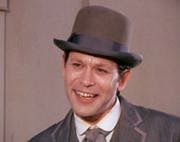
Just plain weird. He's played by a guy named Lev Mailer who apparently is an acting coach currently living here in MN. He looks like he should be in a Kurt Weil production and talks very strangely.
In the end, I think this episode strikes the right balance of science fiction ideas and social/political commentary. Here are a few odds and ends I liked/noted about this one:
"The Red Hour." It's a really interesting idea, a "pressure valve" as Eric calls it in our podcast, for the forcibly contented people under Landru. I also like the way that the story doesn't really explain the reason for it.
Marplon and Reger, the two who resist Landru, aren't your average underground resistance movement. They are actually wracked with doubt and are unsure of what they're doing on some level. All the better for Kirk to swoop in as the confident American to save them!
Kirk vs. Landru the computer god/commie party dictator. As Eric said, it was the first, but far from the last time he's found himself in a position to talk a computer to death. Sometimes the original is the best.
The mystery of how Landru manages to channel his power through thin air as well as telepathically control an entire population is an interesting sci fi idea. It may not be entirely original, but for TV of the 1960s, it must have been pretty fresh and potent.
I really like the teaser/intro of this episode. There is no Captain's Log or other expository dialogue to tell you what Sulu and O'Neil are doing and why they're being chased by these guys in robes. It sets up the episode very well.
So, there you have it. One of the better episodes and we still have some real classics coming up.
Next time: "Space Seed"
Khaaaaaaaaaaaaaaaan!
The drink: more vodka/lemonade.
We have three reviews for you on this one. Plus, an audio podcast!
Here's the podcast (for real fans only--30 minutes of Trek geek yacking!)
I'm going to let Eric start us out:
To pick up where I left off in my last review (“…I want to see science fiction!"), I get what I want with “Return of the Archons". In fact, this episode kicks off a string of excellent episodes that runs right up to the end of the first season.
“Return of the Archons" scores high in pretty much every category. The “cheese factor" is low, the production (acting, directing, cinematography, etc.) is good (maybe great), and the story kicks ass. It’s not only good science fiction, it addresses a social topic very near and dear to me—religion. John and I chatted a bit about this episode, and I think he’s of the opinion that it’s more of a commentary on communism. I can see that, but to me, the religious overtones are blatant: blind obedience and slathering, beatific devotion to an unseen guru (i.e. Landru); the emphasis on unity and brotherhood; referring to the group as a “body"; and perhaps most of all, the violent reprisals for anything that can be vaguely construed as sacrilege. (I half expected Michael Palin to come jumping out yelling “You never expect the Spanish Inquisition!") Of course, in this society, the brainwashing is overt and direct. And instead of leaving a set of teachings (of questionable origin), Landru programmed a highly sophisticated computer to perpetuate his faith. It all boils down to the same thing, though—a repressed, stagnant society where there is no freedom of thought or action.
Which leads to the “Red Hour". In the society in question, everyone under a certain unspecified age periodically goes nuts and has a giant orgy/riot, presumably to vent the emotions that are at all other times suppressed (kind of like the Vulcan pon farr). This is an interesting observation about most of our religions. They demonize some very basic facets of human nature (violence, sexuality, etc.) and try to force their adherents into rejecting or controlling these facets to a ludicrous degree. I’ve often thought that part (maybe a large part) of the high crime rate is that the religions such a large percentage of the population are indoctrinated into don’t teach people how to live with the less genteel aspects of their natures and channel the emotions they generate into healthy outlets. Not that I’m saying Landru’s “Red Hour" is a healthy outlet, but it is an interesting solution to the problem.
So, in any case, the denizens of Beta III had James T. Kirk to rid them of their oppressive guru, which turned out to be a computer. So, once again, we’re dealing with man vs. machine. Or more accurately, Kirk vs. supercomputer. And it won’t be the last time. (Not by a long shot.) But that particular theme is still very well done in this episode. I have to admit that I love watching Kirk out-logic computers until they go nuts and fry themselves. This leads to one small problem, though: despite Kirk’s protests to the contrary, it seems to me that he really did break the Prime Directive. The controlling power in the society may have been passively malignant and repressive, as well as personally repugnant to the good captain, but that really didn’t give him license to destroy it and completely disrupt the life of every person on the planet. And, as Spock alluded, an extensive study of Landru’s computer would’ve been very valuable. But Kirk, as he was wont to do, set the people of Beta III back on a normal, human path. Then again, they weren’t humans. Hmmm…
---
And for the first time, Rob takes a crack at TOS:
Thanks to Eric and John for inviting me to co-blog this one.
"Archons" has always been one of my favorite Trek episodes, and it holds up well. The writers tackled big subjects – totalitarianism, communism, religion, colonialism, and mob psychology– without leaning on specific comparisons with current or historical events (as in 'Patterns of Force" or "The Omega Glory"). There are lots of striking and creepy images, such as the (viewing it now, very well-choreographed) crowd scenes, and the sinisterly-gentle holographic Landru. But there's some fun Kirk-Spock banter as well. And I love the way George Takei and DeForest Kelley play their characters after they've been absorbed. Their portrayals are essential for the plot.
So what's the deal with "the Red Hour"? Probably added as a "fight scene," it gives the story an extra layer of mystery – one that is never explained. My theory: it's the Landru-computer's concession to the id. Humans can't tolerate perfect peace and harmony. Like the underground man says in the Dostoyevsky book -- the crystal palace is lovely, but you wouldn't want to live in it. Deep stuff!
It's been said that Star Trek is all about the Cold War. This episode's a powerful take-down of communism, but it seems to have implications for religion as well. St. Paul referred to the Church as "the Body of Christ." "Archons" is also, less positively, an argument for overthrowing communist governments in Third World countries. Kirk justifies violating the prime directive because it only applies to "living, growing" cultures. Really? He'd make a great CIA lawyer! And the local resistance is led by half-committed wimps who require outsiders (read: Americans) to give them spine.
Some would dismiss as ridiculous Kirk's amazing ability to talk computers into destroying themselves. Well, how else is the Enterprise going to defeat a foe with vast technological superiority? IMHO, that's how "The Squire of Gothos" should have ended. (Sorry, Eric!) That's a classic Trek theme – the triumph of reason and creativity over brute force. I just told my PC: "A question has been put to you. Answer it!"
---
Thanks bro!
All three of us really liked this one. I don't remember it being one of my real faves long ago: the shortage of fistfights and space battles makes that tough when you're ten. However, I have much more appreciation for it as an adult. As Eric and Rob both point out, this episode covers a lot of intellectual ground, much more than the usual TOS Trek episode. I can just imagine the NBC censors looking at this one and saying, "well, that's okay, it isn't about religion. Jesus wouldn't build a mind-enslaving computer to run the Earth!" Uh, yeah. However it happened, this one got on the air with some thought-provoking ideas. It'd be interesting to see what the 1967 audience thought of this one.
This episode does a really good job conveying the creepy oppression of the Landru-state. The way the people behave as well as Sulu and McCoy's behavior after being absorbed makes it even more of a menace. But this guy takes the cake:
Just plain weird. He's played by a guy named Lev Mailer who apparently is an acting coach currently living here in MN. He looks like he should be in a Kurt Weil production and talks very strangely.
In the end, I think this episode strikes the right balance of science fiction ideas and social/political commentary. Here are a few odds and ends I liked/noted about this one:
"The Red Hour." It's a really interesting idea, a "pressure valve" as Eric calls it in our podcast, for the forcibly contented people under Landru. I also like the way that the story doesn't really explain the reason for it.
Marplon and Reger, the two who resist Landru, aren't your average underground resistance movement. They are actually wracked with doubt and are unsure of what they're doing on some level. All the better for Kirk to swoop in as the confident American to save them!
Kirk vs. Landru the computer god/commie party dictator. As Eric said, it was the first, but far from the last time he's found himself in a position to talk a computer to death. Sometimes the original is the best.
The mystery of how Landru manages to channel his power through thin air as well as telepathically control an entire population is an interesting sci fi idea. It may not be entirely original, but for TV of the 1960s, it must have been pretty fresh and potent.
I really like the teaser/intro of this episode. There is no Captain's Log or other expository dialogue to tell you what Sulu and O'Neil are doing and why they're being chased by these guys in robes. It sets up the episode very well.
So, there you have it. One of the better episodes and we still have some real classics coming up.
Next time: "Space Seed"
Khaaaaaaaaaaaaaaaan!
Thursday, August 7, 2008
TOS Rewind #19: "Court Martial"
6/12/2016 update: We belatedly recorded a podcast for this one. Check it out here.
Tonight's episode: Court Martial (2/2/1967). The drink: another Moscow Mule (hey, Costco had a deal on limes!).
In "The Menagerie" we got to see Spock put on trial. This time, it's Kirk's turn: accused of negligence causing the death of one of his crew. Unfortunately, this episode isn't nearly as good. I had a brief chat with Eric about this one and we both agreed that this wasn't Trek at its best. Like the last episode we reviewed, this one isn't really sci fi or even adventure. It was a courtroom drama shoehorned into a Trek episode. The beauty of "The Menagerie" is that it managed to blend courtroom drama with a real science fiction plot. This one has a pretty flimsy techno-plot that I find hard to buy. I'll break this one into the tired pros and cons thing.
Pro:
We get to see Kirk in a new, vulnerable position. By being involved with the death of a fellow officer, supposedly due to bad judgment, he even earns the ire of his colleagues on the starbase. Spock and McCoy naturally stand by their captain, but it looks bad for Kirk. It's worth watching this episode just for that small bit of character development. This was also a brief look at the inner workings of Starfleet; both the justice system and Starfleet Academy are discussed.
Elisha Cook Jr.'s performance as Kirk's attorney is another thing that holds our attention in this episode. Cook was a hard-working character actor who turned up in a ton of films and TV shows. He was a good choice to play the eccentric technophobic lawyer.
Con:
The Ion Pod techno-plot device seemed awfully ridiculous, even by old Trek standards. The idea that Finney could somehow be thrown out of this pod and turn up at some random part of the ship just didn't work for me. Also, how could this "records officer" (what, did he work for HR?) sabotage the Enterprise that Scotty or some engineer couldn't detect it or repair it? There are other examples, but it looks like sloppy writing that is distracting within the context of Trek.
Finney's daughter is inconsolable at the beginning of the episode and is bitter about Kirk supposedly causing her father's death. She has completely reversed her stance later in the show, which I found hard to buy. They sort-of explain this but something doesn't work. I read that there was a scene with her that was left out for time. This might have made this more believable.
The ideas here aren't bad; machine vs. man and a former friend seeking revenge. I have to wonder if the whole Finney resentment thing would have been more effective if the show's format had allowed some way to develop Finney as even a minor character with this showdown building in the background. It certainly would have given this idea and climax a lot more heft. Finney is just another new character we'd never heard of, one with a long history with Kirk. But TOS was, like most TV at the time, quite episodic without the extended continuity and mile-long story arcs of today's TV dramas. It worked well most of the time for TOS and it isn't really fair, I suppose, to compare it like that. But hey, at least we had a fistfight in the engine room...with a really big wrench!
OK Eric, what do you have to say?
...
“Court Martial" is much like “The Conscience of the King" in that it isn’t really Star Trek or science fiction, and it isn’t one of my faves. (It also doesn’t have the advantage of a Shakespearean title or plot.) Like “The Conscience of the King", it’s a story that could’ve been done on any TV drama. And that’s not to say that it’s a bad episode. Samuel T. Cogley (played by the late Elisha Cook) is a lot of fun. I particularly enjoy his impassioned speech about human rights. And the courtroom scenes are good too. Kirk’s testimony is nicely done, and the demonstrations of his crew’s loyalty are touching. I also like the opening scene where Kirk gets into a (verbal) fight with Commodore Stone—I’m not sure whether Kirk is gutsy or foolhardy, but it’s a good scene.
One major problem I have with this episode, other than those I already mentioned, is that it suggests that a non-engineering crew member could sabotage the Enterprise so cleverly and thoroughly that Scotty (the Miracle Worker) couldn’t fix it. Not!
Anyway, as I said before, this isn’t a bad episode, but when I watch a science fiction show (especially Star Trek), I want to see science fiction!
Next time: “Return of the Archons"
Tonight's episode: Court Martial (2/2/1967). The drink: another Moscow Mule (hey, Costco had a deal on limes!).
In "The Menagerie" we got to see Spock put on trial. This time, it's Kirk's turn: accused of negligence causing the death of one of his crew. Unfortunately, this episode isn't nearly as good. I had a brief chat with Eric about this one and we both agreed that this wasn't Trek at its best. Like the last episode we reviewed, this one isn't really sci fi or even adventure. It was a courtroom drama shoehorned into a Trek episode. The beauty of "The Menagerie" is that it managed to blend courtroom drama with a real science fiction plot. This one has a pretty flimsy techno-plot that I find hard to buy. I'll break this one into the tired pros and cons thing.
Pro:
We get to see Kirk in a new, vulnerable position. By being involved with the death of a fellow officer, supposedly due to bad judgment, he even earns the ire of his colleagues on the starbase. Spock and McCoy naturally stand by their captain, but it looks bad for Kirk. It's worth watching this episode just for that small bit of character development. This was also a brief look at the inner workings of Starfleet; both the justice system and Starfleet Academy are discussed.
Elisha Cook Jr.'s performance as Kirk's attorney is another thing that holds our attention in this episode. Cook was a hard-working character actor who turned up in a ton of films and TV shows. He was a good choice to play the eccentric technophobic lawyer.
Con:
The Ion Pod techno-plot device seemed awfully ridiculous, even by old Trek standards. The idea that Finney could somehow be thrown out of this pod and turn up at some random part of the ship just didn't work for me. Also, how could this "records officer" (what, did he work for HR?) sabotage the Enterprise that Scotty or some engineer couldn't detect it or repair it? There are other examples, but it looks like sloppy writing that is distracting within the context of Trek.
Finney's daughter is inconsolable at the beginning of the episode and is bitter about Kirk supposedly causing her father's death. She has completely reversed her stance later in the show, which I found hard to buy. They sort-of explain this but something doesn't work. I read that there was a scene with her that was left out for time. This might have made this more believable.
The ideas here aren't bad; machine vs. man and a former friend seeking revenge. I have to wonder if the whole Finney resentment thing would have been more effective if the show's format had allowed some way to develop Finney as even a minor character with this showdown building in the background. It certainly would have given this idea and climax a lot more heft. Finney is just another new character we'd never heard of, one with a long history with Kirk. But TOS was, like most TV at the time, quite episodic without the extended continuity and mile-long story arcs of today's TV dramas. It worked well most of the time for TOS and it isn't really fair, I suppose, to compare it like that. But hey, at least we had a fistfight in the engine room...with a really big wrench!
OK Eric, what do you have to say?
...
“Court Martial" is much like “The Conscience of the King" in that it isn’t really Star Trek or science fiction, and it isn’t one of my faves. (It also doesn’t have the advantage of a Shakespearean title or plot.) Like “The Conscience of the King", it’s a story that could’ve been done on any TV drama. And that’s not to say that it’s a bad episode. Samuel T. Cogley (played by the late Elisha Cook) is a lot of fun. I particularly enjoy his impassioned speech about human rights. And the courtroom scenes are good too. Kirk’s testimony is nicely done, and the demonstrations of his crew’s loyalty are touching. I also like the opening scene where Kirk gets into a (verbal) fight with Commodore Stone—I’m not sure whether Kirk is gutsy or foolhardy, but it’s a good scene.
One major problem I have with this episode, other than those I already mentioned, is that it suggests that a non-engineering crew member could sabotage the Enterprise so cleverly and thoroughly that Scotty (the Miracle Worker) couldn’t fix it. Not!
Anyway, as I said before, this isn’t a bad episode, but when I watch a science fiction show (especially Star Trek), I want to see science fiction!
Next time: “Return of the Archons"
Tuesday, July 15, 2008
TOS Rewind #18: "Tomorrow is Yesterday"
Today's episode: Tomorrow is Yesterday (1/26/1967) The drink: beer (Blue Moon).
I'll have Eric take the first crack at this one:
“Tomorrow is Yesterday" holds the distinction of being the first Star Trek episode that featured time travel in a significant way. There was a brief instance of time travel at the very end of “The Naked Time", but it was inconsequential and had no impact on the story. In “Tomorrow is Yesterday", however, the Enterprise ends up in 1969 and accidentally destroys a US Air Force jet (an F-4 Phantom, I believe). The pilot, Captain John Christopher, is rescued, but Kirk and crew are then faced with three big problems: how to get back to the 23rd century, how to avoid disrupting the timeline, and what to do with their “guest". These problems are further compounded when Spock discovers that Captain Christopher is destined to father the man who would command the first successful Earth-Saturn probe.
These problems are solved by using what they call the “light speed breakaway factor" to travel back to the instance when the Enterprise intercepts Captain Christopher’s jet and return him at that point. (Trivia note: This is the same technique they use in Star Trek IV to time travel back to 20th century Earth.) I won’t get into the scientific implausibility of this—suffice it to say it’s another instance where suspension of disbelief is required. Otherwise, it’s a perfectly decent story. In particular, I like the fact that the 20th century characters aren’t portrayed as ignorant, incompetent primitives in comparison to their 23rd century counterparts. One thing that surprises me about this episode, however, is that there is little or no commentary on the social/political situation in the United States of the late 1960s. It isn’t a big deal—later time travel episodes, like “Assignment Earth", did so very effectively—it’s just surprising given Roddenberry’s passion for such commentary.
I don’t really have much more to say about this episode. The acting and directing are both good. It isn’t brilliant episode, but it is thought-provoking and entertaining, and that’s enough—they can’t all be gems.
---
First off, now that I've taken my long-ass vacation, it's time to get back on track with the Trek blogging.
As Eric said, this isn't one of the greats, though it is an entertaining one. He also mentioned that this was the first real time travel episode, aside from The Naked Time. I was reading today that this episode was originally intended as an immediate follow-up to that episode, which makes sense. It would have been interesting to have had these two as a 2-parter.
The time travel plot device has since become a staple of the Trek story ecosystem (some would say a tired one). Wait, is there such a thing as a "story ecosystem?" Sounds like BS to me, but I'm going with it. I remember really liking this one as a kid. In those days, the time travel thing hadn't been done so much and it was very compelling. The idea of the Enterprise hovering over "present day" Earth sounded cool.
Looking at it today, it comes off as a bit shallow, or a waste of a dramatic opportunity. However, it does lay some important groundwork for the time travel stories to come. One of the things that I noticed in this viewing was just how unfazed Kirk and the rest are about being in the past and having a guy aboard from the 60s. Kirk seems to be actually amused by the whole thing and almost acts disappointed when we learns that they have to return Capt. Christopher to Earth. It's so sad when your amusement is thwarted by history. The time travel idea would soon be used for a far more serious end in City on the Edge of Forever. Some of the very same ideas thrown about casually in this episode get more serious exploration.
Eric talked about the "slingshot" time warp trick already. The other thing it reminded me of was the kooky ending of Superman: The Movie when he flies around the Earth to turn back the clock. I'm sure there are plenty of other examples of this idea being used in the sci-fi/adventure/action realm.
I sampled the "remastered" version of this episode. I think this time it does improve on the original. For one, you actually get to see the Enterprise flying into the Sun and the breakaway. In the original, the Enterprise model just bounces around in place. Of course, like all the "updates," the new f/x just add a superficial layer onto the the show. Fun to see, but hardly essential.
Next time: “Court Martial"
I'll have Eric take the first crack at this one:
“Tomorrow is Yesterday" holds the distinction of being the first Star Trek episode that featured time travel in a significant way. There was a brief instance of time travel at the very end of “The Naked Time", but it was inconsequential and had no impact on the story. In “Tomorrow is Yesterday", however, the Enterprise ends up in 1969 and accidentally destroys a US Air Force jet (an F-4 Phantom, I believe). The pilot, Captain John Christopher, is rescued, but Kirk and crew are then faced with three big problems: how to get back to the 23rd century, how to avoid disrupting the timeline, and what to do with their “guest". These problems are further compounded when Spock discovers that Captain Christopher is destined to father the man who would command the first successful Earth-Saturn probe.
These problems are solved by using what they call the “light speed breakaway factor" to travel back to the instance when the Enterprise intercepts Captain Christopher’s jet and return him at that point. (Trivia note: This is the same technique they use in Star Trek IV to time travel back to 20th century Earth.) I won’t get into the scientific implausibility of this—suffice it to say it’s another instance where suspension of disbelief is required. Otherwise, it’s a perfectly decent story. In particular, I like the fact that the 20th century characters aren’t portrayed as ignorant, incompetent primitives in comparison to their 23rd century counterparts. One thing that surprises me about this episode, however, is that there is little or no commentary on the social/political situation in the United States of the late 1960s. It isn’t a big deal—later time travel episodes, like “Assignment Earth", did so very effectively—it’s just surprising given Roddenberry’s passion for such commentary.
I don’t really have much more to say about this episode. The acting and directing are both good. It isn’t brilliant episode, but it is thought-provoking and entertaining, and that’s enough—they can’t all be gems.
---
First off, now that I've taken my long-ass vacation, it's time to get back on track with the Trek blogging.
As Eric said, this isn't one of the greats, though it is an entertaining one. He also mentioned that this was the first real time travel episode, aside from The Naked Time. I was reading today that this episode was originally intended as an immediate follow-up to that episode, which makes sense. It would have been interesting to have had these two as a 2-parter.
The time travel plot device has since become a staple of the Trek story ecosystem (some would say a tired one). Wait, is there such a thing as a "story ecosystem?" Sounds like BS to me, but I'm going with it. I remember really liking this one as a kid. In those days, the time travel thing hadn't been done so much and it was very compelling. The idea of the Enterprise hovering over "present day" Earth sounded cool.
Looking at it today, it comes off as a bit shallow, or a waste of a dramatic opportunity. However, it does lay some important groundwork for the time travel stories to come. One of the things that I noticed in this viewing was just how unfazed Kirk and the rest are about being in the past and having a guy aboard from the 60s. Kirk seems to be actually amused by the whole thing and almost acts disappointed when we learns that they have to return Capt. Christopher to Earth. It's so sad when your amusement is thwarted by history. The time travel idea would soon be used for a far more serious end in City on the Edge of Forever. Some of the very same ideas thrown about casually in this episode get more serious exploration.
Eric talked about the "slingshot" time warp trick already. The other thing it reminded me of was the kooky ending of Superman: The Movie when he flies around the Earth to turn back the clock. I'm sure there are plenty of other examples of this idea being used in the sci-fi/adventure/action realm.
I sampled the "remastered" version of this episode. I think this time it does improve on the original. For one, you actually get to see the Enterprise flying into the Sun and the breakaway. In the original, the Enterprise model just bounces around in place. Of course, like all the "updates," the new f/x just add a superficial layer onto the the show. Fun to see, but hardly essential.
Next time: “Court Martial"
Monday, July 7, 2008
My Brother Says It All
7/2012 Update: a series of blog entries from a Norway cruise I was fortunate
enough to take in the Summer of 2008. Although it feels funny to have
relayed trip updates via a blog, it was a pre-Facebook way of telling
friends/family about my travels.
Here you go, Rob telling you all, in a nutshell, what was great about our trip:
Here you go, Rob telling you all, in a nutshell, what was great about our trip:
Subscribe to:
Posts (Atom)